2026-08-29 ·
Tankless Water Heater Repair in Fort Mill: Common Issues and Fixes
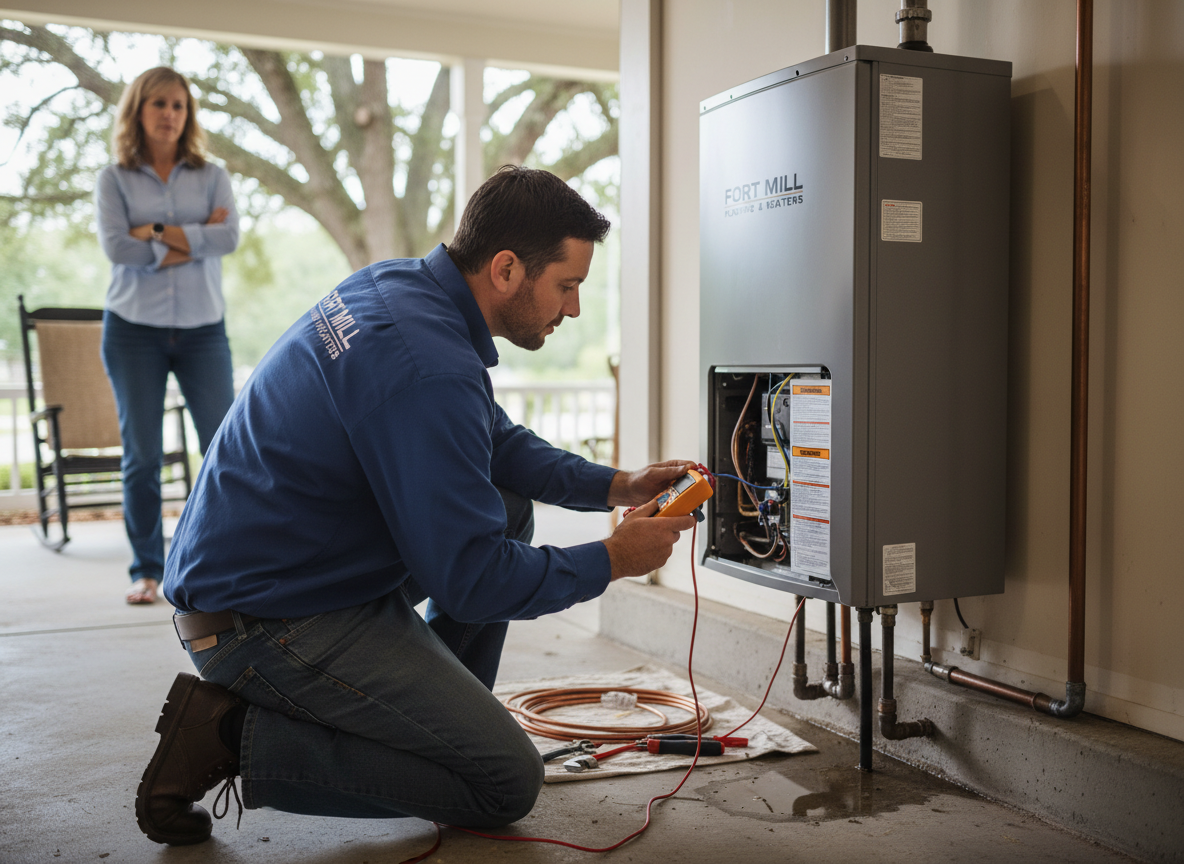
Tankless water heater repair in Fort Mill most often involves descaling mineral buildup or replacing flow sensors, with most jobs in York County homes completed in two to four hours once the unit is accessed.
Mineral Scaling in Humid Subtropical Conditions
Fort Mill's humid subtropical climate keeps groundwater temperatures stable year-round, but the mild winters do not prevent gradual calcium and magnesium deposits inside heat exchangers. Homes built in Baxter Village during the 1990s and early 2000s frequently show reduced flow after seven to ten years because the original units were installed without annual flushing. Technicians isolate the unit, circulate a vinegar solution through the heat exchanger for 45 minutes, then verify restored flow rates of at least 5 gallons per minute at 120 degrees. The same procedure applies to properties near the Anne Springs Close Greenway where slightly harder well-influenced supply lines accelerate scaling. After cleaning, the unit is returned to service without full replacement in roughly 80 percent of calls.
Sensor and Error Code Troubleshooting
Error codes on tankless models serving Springfield neighborhoods usually trace to inlet or outlet thermistors that drift after exposure to temperature swings between Charlotte and Rock Hill supply lines. A technician first records the exact code on the display, then tests resistance values against the manufacturer's chart while the unit runs at low flow. Faulty sensors are swapped in place using factory-matched parts to restore accurate temperature modulation. In older Fort Mill stock near the Fort Mill History Museum, wiring harness corrosion from attic humidity can mimic sensor failure; the harness is inspected and replaced before any board work. These steps prevent unnecessary motherboard swaps that add $300–$600 to the repair.
Flow Rate Drops and Venting Checks
Low hot water volume in Fort Mill tankless systems often stems from clogged inlet screens or undersized venting that restricts combustion air during summer humidity spikes. The screen is removed and cleaned first, followed by a static pressure test on the intake and exhaust runs. Homes in Springfield with long horizontal vent sections require condensate trap clearing every 18 months to avoid back-pressure shutdowns. When flow still falls below 3 gallons per minute after cleaning, the recirculation pump—if present—is checked for impeller wear. These sequential checks keep most repairs under the cost of full tankless water heater repair replacement.
Seasonal Maintenance for Local Housing Stock
Mild winters in York County reduce freeze-protection demands, yet high summer humidity promotes corrosion on exterior units mounted on Baxter Village townhomes. Owners should flush the system each spring and inspect the condensate drain for algae growth that can back up into the heat exchanger. Linking this routine to an existing water heater repair schedule prevents surprise shutdowns during peak evening demand. For readers dealing with separate point-of-use issues, the guide on hot water dispenser repair covers overlapping valve and thermostat diagnostics that apply to tankless setups as well.